From a simple task to a non-standard solution
When a client comes with a request like "we need employee time tracking," the logical first step is to open Zoho People and start configuring. But in practice, such tasks often turn out to be much larger in scope. One of our clients approached us with what seemed like a fairly standard request. He wanted to track the working hours of frontline staff, but as the discussion progressed, the picture began to grow more complex. It turned out that behind this request lay an entire operational model. To be precise, a model involving mobile frontline staff, including:
- Sites, shifts, work orders, or technical cards.
- The need to record actual work completion.
- A large number of employees who cannot be given full system access.
- The need for management reporting by site and by employee.
This is no longer an HR task, and a standard Zoho People solution won't address it.
Key takeaway: Behind a simple request often lies the need to build a fully f ledged operational system.
Why standard solutions didn't work
Initially, standard Zoho tools were considered. Zoho People handles HR tasks well:
time tracking, company structure, time off. But as soon as there's a need to track sites, types of work, execution standards, and real employee actions in the field — its capabilities become insufficient.Zoho FSM is a solution that functionally covers such tasks. However, in this case, it proved economically excessive and did not align with the client's business model.
The result was a situation where one tool didn't support the required logic, while the other was outside the budget.
How we solved the problem at Business Lab
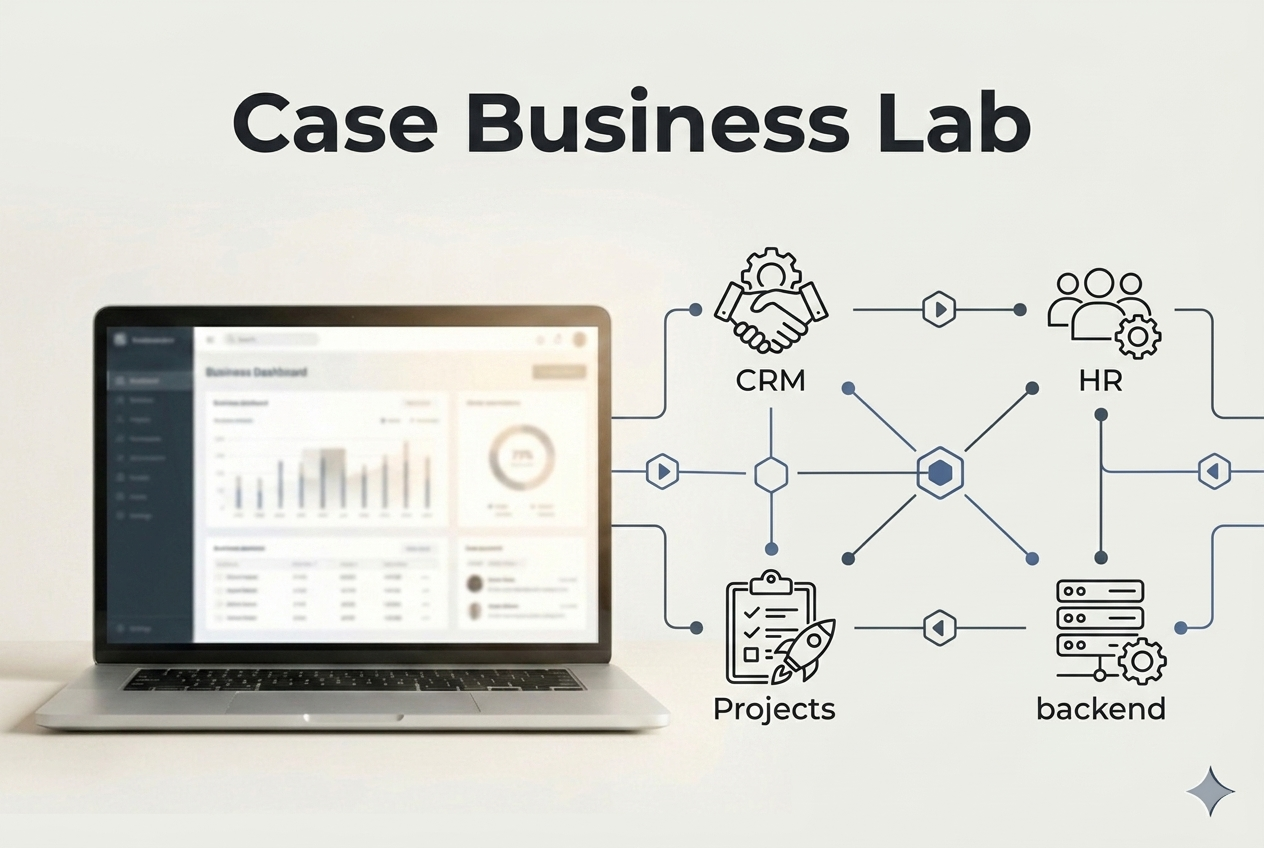
Instead of searching for the "perfect tool," the Business Lab team designed a custom solution using several Zoho applications.
Zoho CRM in this case, not as a sales tool, but as an operational database with a flexible structure.Zoho People remains where it truly excels, within the HR domain: employees, planned workload, team structure.Zoho Catalyst provides data processing logic, integrations, and interaction between modules without giving users excessive access to system interfaces.Telegram mini-app solved the challenge of interacting with frontline staff.
As a result, an employee on site does not interact with a complex system — they only need to open the app, press check-in and check-out, and everything else happens automatically: work completion is recorded, data is linked to sites and tasks, and reports are generated. For the business, this means transitioning from manual or partially automated tracking — with a gap between plan and reality — to full transparency and controllability.
The end result is a system where everything is interconnected: plan and reality align, actions are recorded automatically, and the business gains a clear, transparent view of operations.
Why this matters and when to apply this approach
This case highlights a key idea: the value of Zoho lies not in individual applications, but in the ability to assemble them into solutions tailored to a specific business model. This approach is especially important for companies with mobile staff and site‑based logic, where off‑the‑shelf solutions either don't solve the problem or don't fit within the company's budget.
Therefore, you should start not with choosing a tool, but with designing processes — and this is the essence of Business Lab's approach: we don't just implement Zoho; we design operational systems that genuinely work in real‑world business.
f you are facing a non‑standard challenge and realize that a ready‑made "off‑the‑shelf" solution falls short, it makes sense to begin not with tool selection, but with process design. The Business Lab team helps break down processes, see the real picture, and build a Zoho‑based solution that works specifically for your business model — without unnecessary complexity or overspending.